


Compare providers
Download our outplacement comparison sheet

Request pricing
Compare our rates to other providers
The emergence of AI has made the idea of a safe career a lot more challenging to define. A white-collar, well-paid office job once looked like a secure route to a long-term career.
However, just as blue-collar work was once threatened by technology in factories, AI is now affecting the job security of office workers.
On the flip side, for people who work physically, or with their hands, or care for another person, the outlook can look quite different.
What we did
We surveyed 3,088 workers to determine how secure they feel in their current roles when it comes to the risk of AI replacement. The question we specifically posed was whether they feel happy and secure in their current careers. Here is what we found from the data.
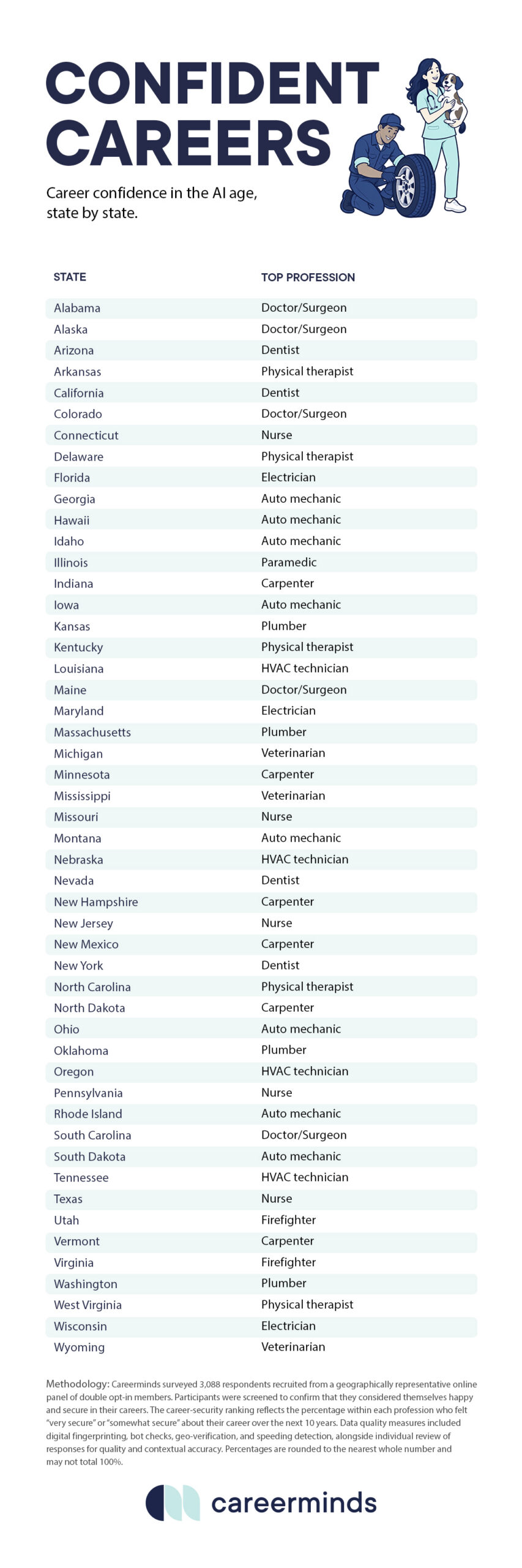
Nurses feel the most secure about the next decade
Respondents were asked a very specific question: how secure they believe their career will be over the coming 10 years. Respondents chose from four options: very secure, somewhat secure, somewhat insecure, or very insecure. The percentages below combine those who felt very secure or somewhat secure.
- Nurse: 81%
- HVAC technician: 80%
- Electrician: 78%
- Dentist: 78%
- Auto mechanic: 78%
- Carpenter: 77%
- Physical therapist: 76%
- Paramedic: 74%
- Firefighter: 73%
- Plumber: 69%
The results are interesting because several of the most confident careers over the next 10 years involve manual work. An LLM may be able to diagnose what the problem is. It may be able to provide instructions on how to fix the issue or help prevent the issue from surfacing, but at present, it is much harder for a robot to crawl into an attic to repair an air conditioning system, rewire a house, or to care for a sick patient.
HVAC technicians are the most satisfied and the most optimistic about AI
HVAC technicians stood out across several different factors. When respondents were asked about how satisfied they are in their current careers, HVAC technicians rated their satisfaction levels at 7.5 out of 10, which was the highest of any profession surveyed. This was followed by carpenters at 7.4, and nurses who averaged 7.3.
Interestingly, HVAC technicians were also the profession most likely to think that the emergence of AI would actually improve their working lives. Over half (53%) stated that AI would make their work either somewhat or much better over the next 10 years. Across all the other careers, however, only 40% believed AI would make improvements. This compared to 31% who actually thought AI would make their work worse, and finally, just over a quarter (28%) said that they anticipated little real difference.
Forget “learn to code”. Parents are choosing the electrician
The clearest indications when it comes to the security of future careers emerged when parents were quizzed about their plans for their own children. Given the risks associated with job replacement by artificial intelligence, 62% of respondents said that, given the choice, they would prefer that their child became an electrician, compared with 38% who would opt for a software developer.
The study findings reflect a clear shift in how future career risk is perceived. Five years ago, before the emergence of chatbots, parents may well have chosen for their children to work in technology over manual work. However, AI is now creating a job market in which doing something physical, face-to-face, or on location may itself be considered a form of future career protection.
How much is an AI-proof career worth?
Our survey also polled respondents on whether job security had a financial value. For example, they were asked a specific question:
“How much of a pay cut would you accept if it could guarantee your job wouldn’t ever be replaced by AI?”
The survey found that 41% of respondents would accept a pay cut today to guarantee that their job would never be replaced by AI. More than a quarter (26%) would accept a cut of at least 20%. That includes 17% of all respondents willing to sacrifice at least 30% of their salary, and 4% willing to give up half.
When it comes to which professions would be most willing to take a pay cut, physical therapists topped the list, with over half (54%) saying they would accept some salary reduction. They were followed by nurses at 51%, while around half of HVAC technicians, dentists, and electricians would also take a pay cut.
Auto mechanics are most likely to choose their career again
To gauge career confidence further, our survey asked workers whether they would choose the same career if they could start over. The profession most likely to make the same choice again was auto mechanics. Among auto mechanics, 71% said they would definitely or probably choose the same career if they were starting again, narrowly ahead of carpenters at 71%. They were followed by nurses at 69%, dentists at 68%, and HVAC technicians at 68%. However, on the other end of the scale, fewer than half of veterinarians said that they would opt to go into their profession again.
Workers feel for those on the other side of the AI divide
People working in relatively secure professions also appear conscious that others may not be as fortunate.
More than three-quarters of respondents, 77%, said they felt sorry for people working in careers at risk of being replaced by AI.
That divide could become increasingly important as automation develops.
Finally, our survey asked respondents aged 55 and above across all professions whether, if given the option, they would accept early retirement now rather than continue working and risk being replaced by AI before reaching the official retirement age. Interestingly, 38% said they would indeed choose to retire early and live off their pension rather than take that risk.
Final thoughts
One thing that stands out from the data is that there appears to be a clear divide when it comes to people’s perception of job security over the next 10 years.
There are those, for example, whose work is mostly physical or human-focused and who are confident about not being replaced by AI. And then there is the other side of the divide, mostly people in office or computer-based careers, who feel far less secure about their future job prospects.
Perhaps the biggest takeaway from the study is what now counts as a desirable career-at least over the next 10 years. Software development, for example, hasn’t suddenly become a bad profession, and an electrician’s job hasn’t suddenly become easy. But when the survey showed that 62% of parents would rather their child become an electrician than a software developer, something has clearly shifted.
For a long time, working within or around technology was considered a surefire way of protecting one’s career. However, it is increasingly becoming less secure.
Methodology
This study is based on a Careerminds survey of 3,088 respondents recruited from a geographically representative online panel of double opt-in members. Participants were screened to confirm that they considered themselves happy and secure in their careers. The career-security ranking reflects the percentage within each profession who felt “very secure” or “somewhat secure” about their career over the next 10 years.
Data quality measures included digital fingerprinting, bot checks, geo-verification, and speeding detection, alongside individual review of responses for quality and contextual accuracy. Percentages are rounded to the nearest whole number and may not total 100%.




bring the CHALLENGE.
wE have the SOLUTION.
Protect your brand and support your people through change. From career transition to leadership development, we bring clarity and care to the moments that matter most.