


Compare providers
Download our outplacement comparison sheet

Request pricing
Compare our rates to other providers
Companies are spending on AI at a pace that would have seemed unthinkable as little as two years ago. What began as a handful of software subscriptions has become a core budget line, with the cost of automation now competing directly with longer-standing investments for finite budget. Gartner forecasts that worldwide AI spending will grow 47% in 2026 to reach $2.69 trillion, and while most of that sits with tech companies, enterprise spending is also on the rise.
What we did
Our report surveyed 600 full-time HR leaders and budget owners on their input into their companies training, L&D, or coaching budget and how this has changed over the past twelve months compared to their spend on AI. We also asked 600 U.S. workers about the other side of the equation: whether they’ve spent their own money on upskilling in the last year, what they spent it on, and why the cost is falling to them rather than their employer.
Companies are pouring money into AI, while L&D budgets shrink
79% of HR leaders said their company’s spending on AI and automation tools increased in the past 12 months, with a third describing the increase as significant. Among the companies spending more, the average increase was approximately $88,000 per year.
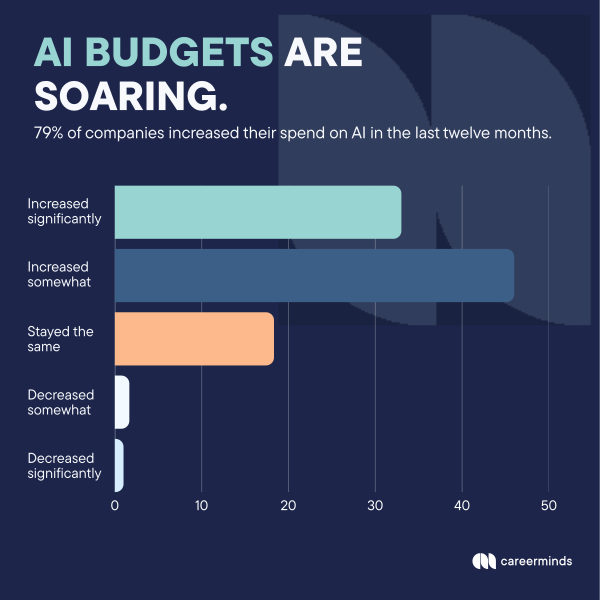
- 42% of companies raised their AI budgets by $50,000 or more
- More than 1 in 5 (21.7%) increased their spending on AI by more than $100,000
Learning and development budgets are moving in a different direction. Where training budgets were reduced, the cuts were substantial, with an average reduction of approximately $126,000 per year.
- More than half (55.9%) of the companies that reduced training budgets cut over $25,000
- Nearly a third (29.4%) cut more than $100,000 from their annual training spend
- Almost half (47.1%) of companies increased their AI spending at the same time as cutting learning and development budget
Do HR leaders believe AI can replace employee training?
The shift in spending on learning and development to AI raises a question of what companies expect AI to do in place of formal skill development. We asked HR leaders whether they thought AI tools could replace some or all the employee training and coaching their company previously paid for, and the majority said yes.
- 82% of HR leaders said AI can replace at least some of the training and coaching their company used to pay for
- Around 2 in 3 (65.7%) said AI can replace some of it
- Nearly 1 in 6 (15.8%) said AI can fully replace it
- Only 17.2% said AI cannot replace the training their company pays for
AI is already useful for parts of workplace learning, like delivering content and answering questions on demand. However, when companies invest in training, especially coaching and leadership development, they’re also getting human feedback, honest answers about performance, and guidance that’s shaped around the trainee. For the 15.8% of HR leaders who believe AI can fully replace training, that’s a significant gamble.
Over half of companies would trade employee upskilling for AI
Beyond believing AI can replace training, some companies admit they would be happy for the development of their people to slow because of it. When we asked respondents whether their company would accept slower skill development in exchange for greater investment in AI, more than half said yes.
- 53.7% of HR leaders said their company would accept, or has already accepted, slower employee skill development in exchange for greater AI investment
- A third (34.3%) said no, and 12% weren’t sure
The same market pressures pushing companies to invest in AI are also raising the bar for what employees need to do to stay employable in a tough job market. Workers are being asked to meet a higher standard with less support, leading them to pay for their own development.
Nearly half of employees are paying for their own development
For employees, development is clearly not optional in the current economy. Tasked with upskilling to ensure their skills aren’t obsolete, they’re funding their own growth while employers are cutting spend.
- Nearly half (47.8%) of workers spent their own money on upskilling or career development in the past 12 months
- A further 27.3% haven’t yet, but plan to in the next 12 months
- Workers who paid for their own development spent an average of $788
- Around 1 in 5 (19.5%) of spenders paid more than $1,000 of their own money
Workers are self-funding to leave their current job
When workers fund their own growth, the skills belong to them. A meaningful share of workers who pay for their own upskilling — because their company doesn’t — are doing so in order to leave.
- The most common goal of 41.8% of workers funding their own progression was getting promoted at their current company
- A similar share (22%) are upskilling to get a better-paid job at a different company
- Around 1 in 5 (22%) said their main goal is keeping their current job and staying employable as AI changes their role
A fifth of upskilling workers are doing so to avoid falling behind, paying out of their own pocket because they don’t trust their current skills to hold their place as AI reshapes their role. Interestingly, the money worker are spending isn’t to benefit their employer, given a quarter of self-funders are aiming at a job somewhere else.
AI investment isn’t slowing down, but this research raises a question of what happens to employee development while budgets are being redrawn around it. Workers are already answering that question for themselves, spending their own money to keep up with roles that are changing faster than the support around them.
For HR teams, the opportunity is to make sure development doesn’t become the quiet casualty of the AI budget. Structured career development gives employees a reason to build their new skills where they are rather than somewhere else, and leadership coaching remains one of the areas where human feedback still does the work no tool can. Companies that hold onto both will get more from their AI investment, not less, because the returns depend on people who are still growing.
Methodology
This report is based on two surveys commissioned by Careerminds and conducted on Pollfish in July 2026. Respondents to survey one all worked in HR, People or Talent departments and either owned or had singificant input into their company’s training, learning and development or coaching budget. The second surveyed 600 employed U.S. workers.




bring the CHALLENGE.
wE have the SOLUTION.
Protect your brand and support your people through change. From career transition to leadership development, we bring clarity and care to the moments that matter most.