


Compare providers
Download our outplacement comparison sheet

Request pricing
Compare our rates to other providers
In the weeks following a workforce reduction, the most visible signs of damage start to appear in the form of turnover increases, productivity dips, and weak engagement. According to research from HBR, companies that conduct layoffs saw around a 20% decline in job performance, a 41% decline in job satisfaction and a 31% increase in voluntary turnover among remaining employees.
In fact, our own Layoff Communications report found that more than half (53%) of remaining workers said their trust in their employer had decreased following a layoff, affecting brand reputation, customer relationships, and a company’s ability to retain top talent.
While the immediate priority for HRs is usually the operational side of job cuts such as separation logistics, severance, and offboarding communications, the longer-term challenge is rebuilding the trust and engagement that takes a hit in the months that follow. Done well, a thoughtful post-layoff strategy can preserve confidence in leadership and speed up culture recovery.
What we did
Our Layoff Culture Recovery report surveyed 600 full-time U.S. HR leaders who had either led or been directly involved in a layoff within the past 24 months. The findings reveal how long it takes for company culture to recover after a layoff, where employee trust takes the biggest hit, and which strategies HR teams say make the most meaningful difference in rebuilding trust quickly.
How long does it take company culture after layoffs?
When HR leaders were asked how long their company’s workplace culture and employee trust took to fully recover from their most recent layoff, the answers spread across a wide range. Among the 69.8% of respondents whose companies have fully recovered, the average time to return to pre-layoff culture was 7.2 months.
• 40.2% of HR leaders said their company’s culture recovered within six months
• 58.5% said recovery was complete within twelve months
• The most common time period was 3-6 months, reported by 23.0% of all respondents
While most companies bounce back within a year, a significant number do not. One in four HR leaders (25.2%) said their company has not yet fully recovered from its most recent layoff. Of those, 4.7% stated they didn’t think their culture will ever return to the way it was before the cuts.
Where do layoffs damage employee trust the most?
Not all forms of employee trust fall, or recover, at the same rate. HR leaders were asked to rate three different dimensions of trust at three different points in time: before the layoff, in the weeks following immediately afterward, and today.
When comparing average ratings before the layoff to the weeks immediately afterwards:
- Trust in senior leadership fell by 18.4%
- Trust in direct managers fell by 14.7%
- Confidence in the company’s long-term future fell by 19.1%
Confidence in the company’s future fell the most, and has also recovered the slowest. Even today, average trust ratings remain below where they stood before the layoff:
- Trust in leadership is still 10.3% below pre-layoff levels
- Trust in direct managers, while recovering faster, is still 7.3% below pre-layoff levels
- Confidence in the company’s long-term future is still 12.8% below pre-layoff levels
The research shows that frontline managers, who are absorbing day-to-day work of recovery, are doing the most impactful work to regain trust after a workforce reduction. Direct managers are typically more visible than senior leadership in routine interactions, and less associated with the decision to cut headcount.
What strategies rebuild company culture fastest after layoffs?
To understand which actions make the biggest difference, HR leaders identified each strategy their company implemented during or after the layoff. The research then compared recovery times between the companies that used each strategy and those that didn’t, to see which actions were associated with the fastest return to pre-layoff culture.
Leaders whose company held a team event after a layoff reported recovery times that were 22.1% faster than those that didn’t, showcasing a faster recovery than any other strategy. Team event can give teams space to process the loss of their offboarding colleagues together and rebuilds the informal social fabric that gets damaged when people are removed from it.
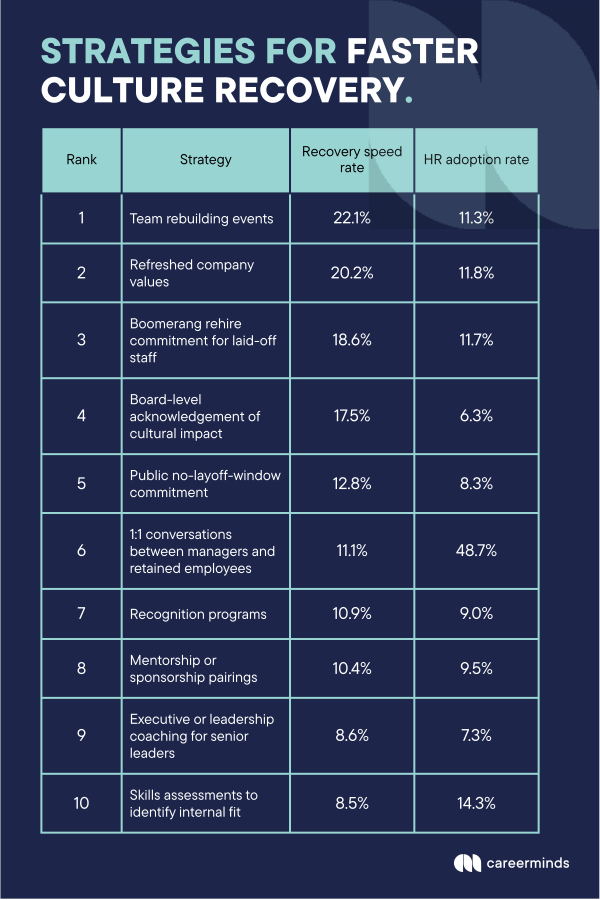
The second most effective tactic is a refreshed company valued statement or employee value proposition, used by just 11.8% of companies and tied to 20.2% faster recovery. After a workforce reduction, the company that employees originally signed up for feels like a different organization. A refreshed valued statement acknowledges that change head-on, shows transparency, and gives employees something new to commit to.
The strategies that aren’t moving the needle on culture recovery
Unfortunately, not every post-layoff action speeds up culture recovery. While tactics that companies reach for first are well-intentioned and in some cases, universally expected, the data suggests they aren’t where the cultural repair work happens.
A post all-hands town hall is the third-most used post-layoff action found, conducted by 36.8% of companies. Yet, despite the importance of giving employees a chance to hear directly from leadership, companies that held one recovered just 0.3% faster than those that didn’t.
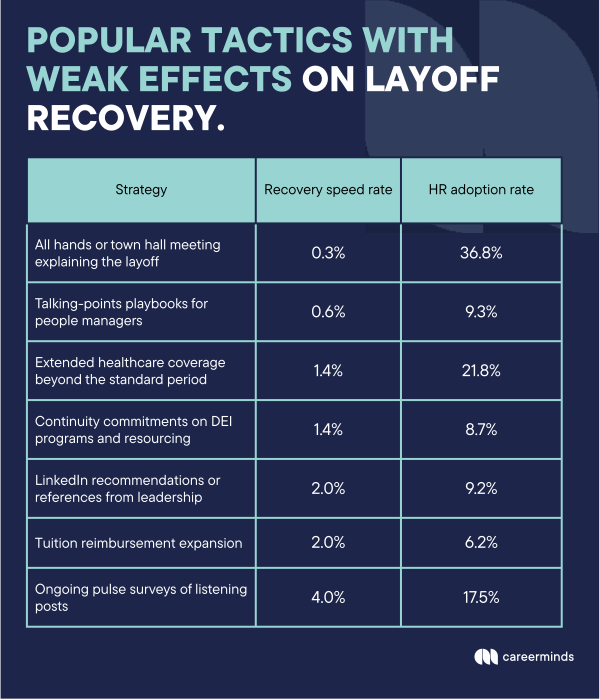
An all-hands town hall is the third-most used post-layoff action found, conducted by 36.8% of companies. Yet, despite the importance of giving employees a chance to hear directly from leadership, companies that held one recovered just 0.3% faster than those that didn’t.
Which talent investments help culture recover faster?
With layoffs, comes the removal of a sense that a company is moving forwards and actively investing in the employees who remain. The strategies most associated with recovering culture the fastest are ones that put that investment back, in ways the rest of the workforce can see.
Mentorship and sponsorship pairings, used by 9.5% of HR leaders, are tied to 10.4% faster culture recovery. Pairing retained employees with new mentors or sponsors rebuilds connective tissue that can be lost with offboarding employees and tells the team that leadership still sees their growth and career development as worth investing in.
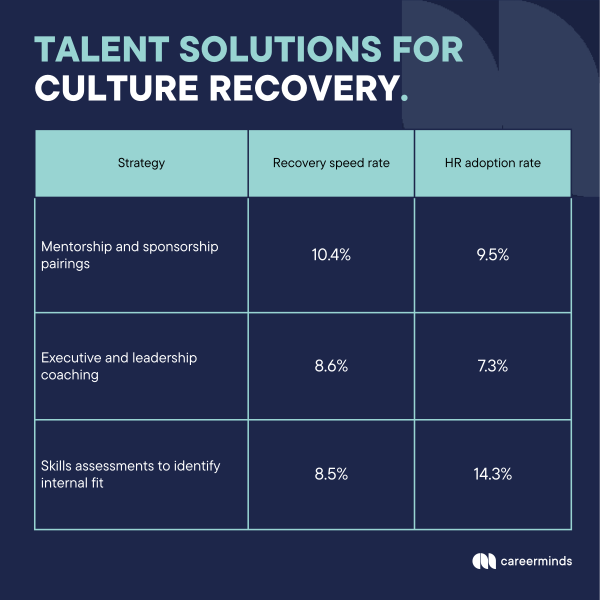
Senior leaders carry much of the trust damage caused by a layoff, and executive and leadership coaching, used by 7.3% of companies and tied to 8.6% faster recovery, helps them recover credibility with the workforce.
Visible investment in the people who remain reaffirms their place in the company’s future. It tells the remaining team that the layoff wasn’t a withdrawal of support, but the start of a more focused investment and therefore rebuilds trust.
Methodology
This report is based on a survey conducted by Careerminds in May 2026, fielded on Pollfish to 600 full-time HR leaders. All respondents were either HR managers or above whose companies had conducted a layoff or workforce reduction within the past 24 months.
Trust was measured using a 0 to 10 rating scale, where 0 represented “no trust at all” and 10 represented “complete trust”. The percentage declines reported in this piece reflect changes in those mean scores.
Recovery duration was reported in banded ranges (less than 3 months through 19 to 24 months), with each band assigned its midpoint value for analysis. Mean recovery time was calculated across the respondents whose companies had fully recovered, then compared between adopters and non-adopters of each strategy. The percentage faster recovery is the difference between those two means, divided by the non-adopter mean. Strategies with fewer 20 adopters were excluded.




bring the CHALLENGE.
wE have the SOLUTION.
Protect your brand and support your people through change. From career transition to leadership development, we bring clarity and care to the moments that matter most.