

Why long-tenured workers are the hardest to transition after a layoff
April 16, 2026 Written by Careerminds

Compare providers
Download our outplacement comparison sheet

Request pricing
Compare our rates to other providers
For years, layoffs have operated on a ‘last in, first out’ principle, suggesting that newer employees carry the greatest risk. They’re less embedded, less expensive to exit, and less connected to institutional knowledge. However, through multiple economic factors, tenure doesn’t protect against layoffs in 2026.
Workplace loyalty has shifted significantly since the pandemic. American workers now spend a median of just 4.1 years with their employers, and today’s workforce is more mobile, more market-aware and less likely to commit to a single employer for the long haul than previous generations. However, there are still a significant number of employees that give five, ten or more years to a single organization and in today’s economy, those employees are finding themselves included in layoffs that tenure would have once shielded them from.
Long-tenured employees, those who have given five, ten years to an organization, are often the least prepared, the most emotionally exposed and the hardest to transition when they’re eventually let go.
What we did
In April 2026, Careerminds surveyed 900 workers who had been laid off from a role that they held for five or more years of service, to understand the cost of layoffs on long-tenured employees and what it means for the HR leaders managing those transitions.
The employer-employee psychological contract
With a culture of ‘last in, first out’, an unwritten agreement has formed in the minds of long-serving employees. While it is never signed, never formalised, there is a belief that the longer you stay at a company, the safer you are.
The federal workforce is the most visible example of this in recent years. For decades, government employment was actively sold as the ultimate safe haven, a career path promising stability and security until retirement. When mass layoffs hit without warning, the workers who had built the longest careers there found themselves unprepared for the transition.
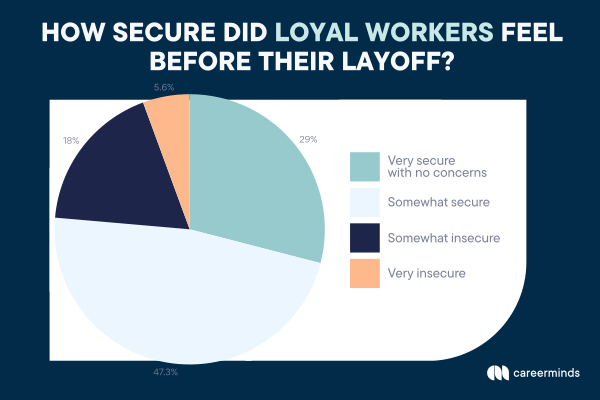
Before their layoff, more than three quarters of long-tenured workers (76%) described themselves as feeling very or somewhat secure in their jobs. Nearly three in ten (29%) reported having no concerns about losing their job.
More than seven in ten long-tenured workers believed their terms of service would protect them from being laid off.
Of those, more than one in four (26.7%) held that belief with complete conviction, whereas just 12.2% didn’t associate long tenure with job security.
Not only that, but this sense of security extended beyond simply feeling immune to layoffs. More than half of those surveyed (58%) had actively turned down at least one other job opportunity before their layoff, having trusted that their tenure made the risk of leaving unnecessary.
Two-thirds (66.3%) of long-tenured workers felt blindsided when their layoff was announced.
Nearly a third (31.2%) said the news came completely out of nowhere, with no indication a layoff was coming. A further 35.1% described themselves as very surprised, having had little warning before the announcement was made.
Long-tenured workers were the least prepared for unemployment
Years of settled employment, and little incentive to entertain other job opportunities, meant loyal workers were less prepared for unemployment than colleagues who had moved around more.
Almost half of those surveyed (46.5%) had a resume that was either significantly out of date or didn’t exist at all. Just 13.8% could have applied for a new role with their resume.
More than half (53.3%) of long-tenured workers had a mostly or completely inactive professional network when their layoff hit.
Of those, 16.2% said they hadn’t meaningfully networked in years. Just 11.1% had an active network they could have leaned on straight away.
Long-tenured workers felt their service wasn’t reflected on the way out
When a long-serving employee is laid-off, years of strong performance, internal advocacy and relationship building creates a reasonable expectation that their tenure will count for something on the way out. However, for many workers, that wasn’t the case.
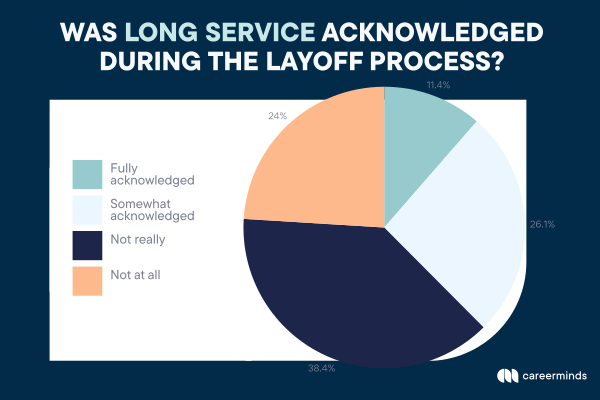
Almost two-thirds of respondents (62.4%) said their tenure wasn’t really, or definitely wasn’t, reflected in how they were treated during the layoff process. A quarter of which (24%) felt their exit was handled in exactly the same way as it would have been for a newer employee.
While severance pay is not a legal requirement, for long-tenured workers the expectation that years of service is reflected in an exit package is held. Nearly half (45%) received no severance pay after giving five or more years of service, and a further 23.6% received less than they anticipated given their tenure.
For many, this landed at the worst possible time. More than two in five (40.7%) had less than one month of living expenses saved at the point of layoff, and some had none at all. Nearly 30% had between one and three months worth of salary saved.
Nearly two-thirds of long-tenured workers (63.3%) were offered no outplacement support upon their exit, no career coaching, no resume help, no job search guidance.
These employees arrive at a time of transition with dormant networks, out-of-date resumes, and no experience in job hunting. Outplacement is one area where organizations can make a genuine difference in how a long-tenured employee lands.
The emotional toll of layoffs on long-tenured workers
For loyal workers, the loss of a role they had committed years to carries a significant emotional weight alongside it.
When asked to name the emotion that defined their experience in the weeks and months following their layoff, financial stress came out on top, cited by nearly a quarter of respondents (24.1%). Depression or persistent low mood was the most prevalent emotion for 22.5%, while 18.4% said anxiety of panic best described how they felt. For others, the defining feeling was a loss of professional confidence (11.1%) or anger or resentment towards their former employer (10.4%).
For those who believed their tenure would protect them, a layoff can be taken as a loss of trust, which can impact how long it takes for a long-tenured employee to emotionally recover from that breakdown of trust.
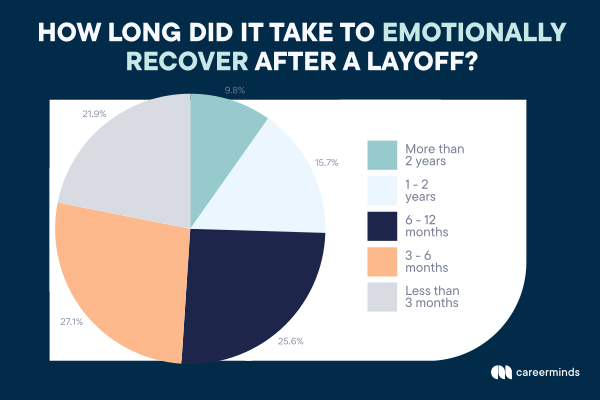
More than half of respondents (51%) took longer than six months to emotionally process their layoff. One in four (25.4%) took more than a year.
A worker who is still grieving the loss of a role they never expected to lose isn’t in the right headspace for a job search. For long-tenured employees in particular, effective transition support has to start before the resume is opened, helping someone process the change and rebuild their sense of professional identity before the practical work begins.
The impact of layoffs on loyalty
The research also finds that a long-serving employee relationship with loyalty is fractured after a layoff. Mor than half (58%) of those surveyed said they are now less loyal to employers as a direct result of their experience. A quarter (25%) described themselves as significantly less loyal, whereas only 16.4% said their attitude to hasn’t changed.
Methodology
Careerminds surveyed 900 workers who had been laid off after five or more years of continuous service at a single employer. Respondents were based in the United States and recruited via Pollfish. The survey was conducted to understand the experience of long-tenured employees through a layoff, covering job security, practical preparedness, the exit process and emotional recovery.




bring the CHALLENGE.
wE have the SOLUTION.
Protect your brand and support your people through change. From career transition to leadership development, we bring clarity and care to the moments that matter most.