


Preparing for a RIF?
Download our Essential Guide to Handling a Layoff

Request pricing
Compare our rates to other providers
A furlough letter is a written notice that tells an employee their work and pay are pausing temporarily while they stay employed.
It states the reason, the start and return dates, what happens to benefits, the no-work rule, and how to claim unemployment.
The template below is yours to copy and adapt.
Everything around it explains what each part does and the legal rules that decide how you word it.
Furloughs sit alongside layoffs and reductions in force as ways to cut costs, and a clear letter is what keeps the process clean.
What is a furlough letter?
A furlough letter is a formal notice from an employer placing an employee on temporary unpaid leave while keeping them on the payroll.
The employee keeps their job and usually their benefits, which signals you plan to recall them.
A furlough is mandatory, employer-initiated, and short-term by design.
The employee does no work and receives no pay for the furloughed time, but the employment relationship continues.
That continuing relationship is the whole reason the letter reads the way it does.
It sets a return expectation, so the wording stays forward-looking rather than final.
This is also the line that separates a furlough from a layoff, which ends employment outright.
What should you include in a furlough letter?
Every furlough letter needs six core components: the reason, the effective dates, the no-work rule, benefits status, unemployment information, and an HR contact.
Miss one and you create confusion, compliance risk, or both.
These six map to the questions every furloughed employee asks first:
- Reason for the furlough. State plainly why this is happening, such as a seasonal slowdown, budget pressure, or a temporary shutdown. Make clear it’s about business conditions, not the employee’s performance.
- Effective dates and duration. Give the exact start date and the expected return date. If you don’t know the end date, say it’s temporary and indefinite, and commit to regular updates.
- The no-work rule. State that the employee cannot perform any work during the furlough, including email and quick calls. This protects you under the FLSA, covered below.
- Benefits status. Explain what happens to health, dental, and vision coverage, how premiums get paid, and whether PTO can be used or keeps accruing.
- Unemployment information. Tell them they may be eligible and point them to their state agency. Adding your state unemployment account number speeds up their claim.
- HR contact. Name one person, with email and phone, who handles questions.
Get these in writing and you stay ahead of the rumor mill.
That matters: 34% of employees first learned about layoffs through rumors, gossip, or workplace whispers (Careerminds, How Layoff Communications Affect Trust and Re-employment, 2025).
Sample furlough letter template
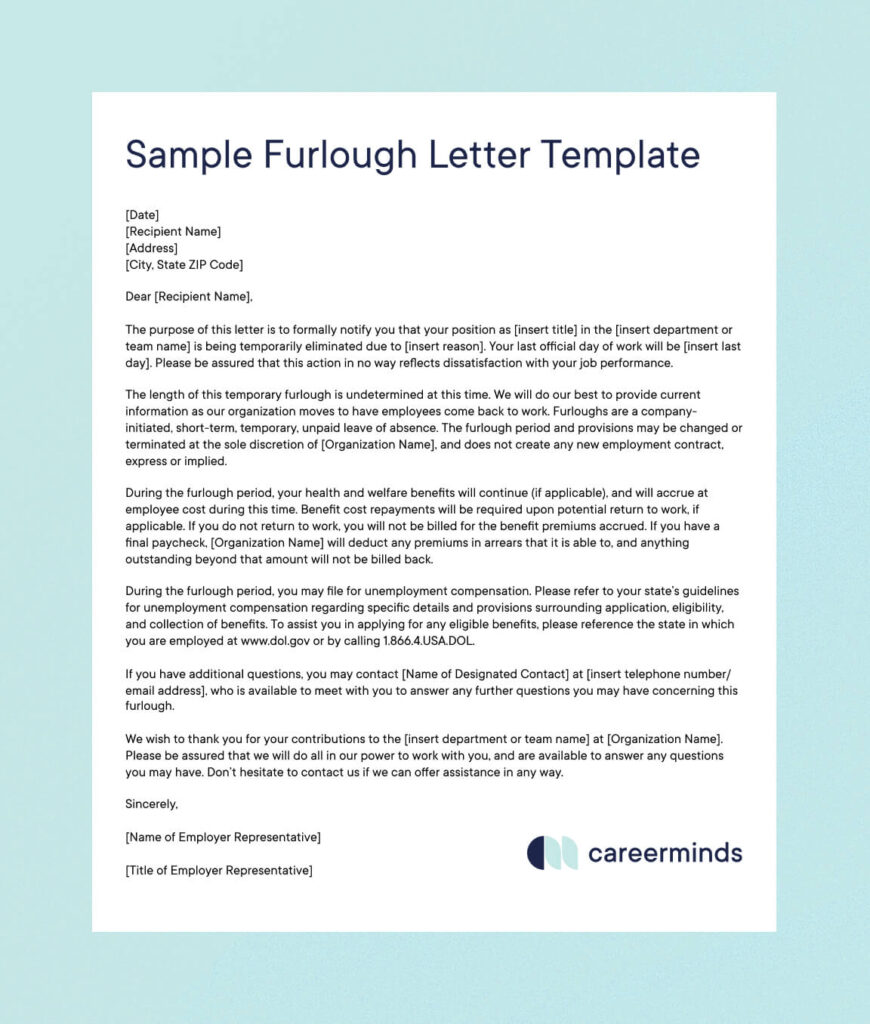
Here’s a furlough letter template you can copy and customize and there’s little small talk in it on purpose.
Like a layoff letter, it carries a lot of information quickly, so it gets to the point.
Copyable furlough letter example
[Date]
[Recipient name]
[Address]
[City, state ZIP code]
Dear [recipient name],
The purpose of this letter is to formally notify you that your position as [insert title] in the [insert department or team name] is being temporarily paused due to [insert reason]. Your last working day before the furlough will be [insert last day]. Please be assured that this action in no way reflects dissatisfaction with your job performance.
The length of this furlough is undetermined at this time. We’ll share current information as our organization moves to bring employees back to work. A furlough is a company-initiated, short-term, temporary, unpaid leave of absence. The furlough period and provisions may be changed or ended at the sole discretion of [organization name], and this letter does not create any new employment contract, express or implied.
During the furlough, you’re placed in a non-duty, non-pay status. You’re not permitted to perform any work on behalf of [organization name], including checking company email, accessing internal systems, or responding to work calls.
During the furlough period, your health and welfare benefits will continue if applicable, and will accrue at employee cost during this time. Benefit cost repayments will be required upon your return to work, if applicable. If you don’t return to work, you won’t be billed for the benefit premiums accrued. If you have a final paycheck, [organization name] will deduct any premiums in arrears that it’s able to, and anything outstanding beyond that amount won’t be billed back.
During the furlough period, you may file for unemployment compensation. Please refer to your state’s guidelines regarding application, eligibility, and collection of benefits. To assist you in applying, reference the state in which you’re employed at www.dol.gov or call 1.866.4.USA.DOL.
If you have additional questions, you may contact [name of designated contact] at [insert telephone number or email address], who’s available to answer any further questions you have about this furlough.
We want to thank you for your contributions to the [insert department or team name] at [organization name]. We’ll do all in our power to work with you, and we’re available to answer any questions you have. Don’t hesitate to contact us if we can help in any way.
Sincerely,
[Name of employer representative]
[Title of employer representative]
This is a starting point, not a one-size-fits-all document.
Every organization and every furlough differs, so work closely with your legal counsel to confirm the wording complies with all applicable local, state, and federal furlough laws.
What are the legal rules for furloughing employees?
Two federal rules govern most private-sector furloughs: the FLSA, which controls pay for salaried staff, and the WARN Act, which can require advance notice for large furloughs.
The IRS does not set rules for how private employers run or announce a furlough, despite how often that gets searched.
The most common and costly mistake involves exempt, salaried employees under the Fair Labor Standards Act.
If an exempt employee does any work during a furloughed week, even answering one email, you owe their full salary for that entire week.
The fix is structural:
- Furlough exempt employees in full-week blocks, Sunday through Saturday.
- Revoke email and system access during the furlough window.
- State the no-work rule in writing in the letter itself.
Hourly, non-exempt employees are simpler.
You only pay them for hours actually worked, so a furlough can be a partial week or a full stop.
The U.S. Department of Labor sets out the salary-basis test that makes the full-week rule matter.
The federal WARN Act adds a second layer for larger employers.
Companies with 100 or more employees may owe 60 days’ written notice when a furlough is expected to last six months or longer and affects 50 or more people at one site.
States including California, New York, and Illinois run stricter “mini-WARN” laws with lower thresholds, so check both.
The Department of Labor’s WARN guidance covers the federal version fully.
When should you use a furlough instead of a layoff?
Use a furlough when the slowdown is temporary and you expect to recall people.
It lets you cut labor costs without losing trained staff, which usually costs far less than hiring and onboarding replacements once work returns.
The math favors a furlough whenever the role will still exist in a few months.
Seasonal businesses are the clearest case.
A landscaper in winter or a resort in the off-season furloughs staff, closes for the slow stretch, and reopens with the same team.
Others use short furloughs to balance a budget, such as one unpaid week or a recurring furlough day, instead of permanent cuts.
A furlough stops making sense when the downturn is structural rather than seasonal.
If the role won’t return, a furlough only delays the harder decision and stacks benefit-cost questions on top of it.
At that point a reduction in force is the more honest path, and other alternatives to layoffs may fit better still.
Match the tool to the problem: furloughs for temporary gaps, permanent reductions for permanent change.
Key takeaways
- A furlough letter places an employee on temporary unpaid leave while keeping them employed, which is what separates it from a layoff.
- Every furlough letter needs six parts: reason, effective dates, no-work rule, benefits status, unemployment information, and an HR contact.
- Under the FLSA, an exempt employee who does any work during a furloughed week must be paid the full week, so furlough salaried staff in full-week blocks.
- The WARN Act can require 60 days’ notice for furloughs of six months or more affecting 50 or more people, and state mini-WARN laws set lower thresholds.
- The IRS does not regulate private-sector furloughs. The Department of Labor does, through the FLSA and the WARN Act.
Frequently asked questions
A few questions come up on almost every furlough.
Do furloughed employees still get benefits?
Often, yes. Many health plans let furloughed employees keep coverage for a set period, frequently with the employee paying their share of premiums.
Some plans end coverage once unpaid leave passes a threshold, which triggers COBRA.
Confirm the rules with your plan provider before you write the letter so the benefits section is accurate.
Can a furloughed employee collect unemployment?
Usually, yes. Furloughed employees are typically eligible because they have a clear, continuing tie to their employer, and state agencies tend to view these claims favorably.
Eligibility and amounts vary by state, so direct employees to their state workforce agency to file.
Is a furlough the same as a layoff?
No. A furlough is a temporary, unpaid pause with the employee staying on the payroll and expected to return, while a layoff ends the employment relationship.
The letters differ accordingly: a furlough letter sets a return expectation, while a layoff letter handles final pay and separation.




bring the CHALLENGE.
wE have the SOLUTION.
Protect your brand and support your people through change. From career transition to leadership development, we bring clarity and care to the moments that matter most.