

How to write a layoff letter due to restructuring (with template)
June 16, 2026 Written by Aley Brown

Preparing for a RIF?
Download our Essential Guide to Handling a Layoff

Request pricing
Compare our rates to other providers
A layoff letter due to restructuring is a formal written confirmation that an employee’s role is being eliminated because the business is changing how it is organized, not because of performance.
It states the final date of employment, pay and benefit details, and next steps, and it follows a verbal notification rather than replacing it.
The word “restructuring” carries legal weight, so the reason must match what leadership says everywhere else.
Most organizations fail at the communication step.
Only 27% of laid-off employees heard the news directly from their manager or HR (Careerminds, How Layoff Communications Affect Trust and Re-employment, 2025).
A clear restructuring letter is where you fix that.
What is a layoff letter due to restructuring?
A layoff letter due to restructuring is a formal document that notifies an employee their position is being eliminated because the organization is changing its structure, such as merging departments, removing layers, or shifting priorities.
It records the separation in writing, confirms the last day of employment, and sets out what the employee receives and what they need to do next.
Restructuring is a business-design reason, not a financial or performance one and that framing matters.
A restructuring layoff says the role no longer fits the new structure, which is different from a budget cut, a closure, or a dismissal for cause.
The letter must make that explicit, because vague wording invites disputes about whether the separation was really performance-related.
A restructuring layoff letter serves three jobs at once:
- Legal record: It documents the date, reason, and terms, which protects the organization if the separation is later challenged.
- Practical handover: It tells the employee how final pay, benefits, and company property will be handled.
- Reputational signal: It shows remaining staff and the wider market how the organization treats people during a structural change.
The letter is not the place to explain the full business case for restructuring.
It confirms a decision already communicated in person and gives the employee a clear, written reference they can act on.
What should a restructuring layoff letter include?
A restructuring layoff letter should include the separation statement, the restructuring reason, the effective date, compensation and benefits details, property return instructions, support resources, and a point of contact.
Miss one of these and the employee is left guessing, which is exactly when disputes and complaints start.
Every restructuring layoff letter needs these seven elements:
- Separation statement: State directly that the role is eliminated and employment will end.
- Restructuring reason: Name the structural change, such as a department merger or realignment, and confirm it is not about performance.
- Effective date: Give the precise last day so pay and benefit timelines are unambiguous.
- Compensation details: Explain when and how the final paycheck arrives, including any accrued, unused PTO payout, plus severance terms.
- Benefits information: Cover what happens to health coverage, COBRA eligibility, and retirement plans.
- Transition support: Detail outplacement coaching, resume help, or any Employee Assistance Program access.
- Property and contact: List what must be returned, by when, and name a person for follow-up questions.
Keep each point factual.
The letter works best when an employee can read it once, under stress, and know exactly where they stand.
How to write a layoff letter due to restructuring
Write the restructuring layoff letter as a follow-up to the in-person notification, lead with the decision, then move through logistics in a fixed order.
The steps below keep the letter clear and legally consistent, and align with the wider process for how to write a layoff letter across a reduction.
- Address the employee by name: Personalize each letter so the right terms reach the right person.
- State the decision in the first sentence: Say the role is eliminated due to restructuring and give the final date. Do not bury it.
- Tie the reason to the structural change: Name the merger, realignment, or layer removal so the employee cannot read it as a disguised firing.
- Detail compensation: Specify final paycheck timing, PTO payout, and severance, including any agreement they must sign.
- Explain benefits: Cover health coverage end dates, COBRA, and retirement.
- List logistics: Give property return items, deadlines, and the offboarding contact.
- Close with appreciation and a signature: Thank the employee briefly and sign with a name and title.
One failure mode shows up repeatedly: managers soften the opening with euphemisms like “transitioning” or “right-sizing.”
The employee finishes the paragraph unsure whether they still have a job.
Ambiguity is not kindness but clarity is.
The payoff for getting this right is measurable.
39% of employees who perceived layoff communications as fair found a new role within one month (Careerminds, How Layoff Communications Affect Trust and Re-employment, 2025).
A clear, respectful restructuring letter is part of what makes the process feel fair.
Layoff letter due to restructuring template
Use the template below as a starting point, then adapt it to your specific restructuring.
It assumes severance is offered in exchange for a signed agreement, which is standard for restructuring layoffs at most organizations.
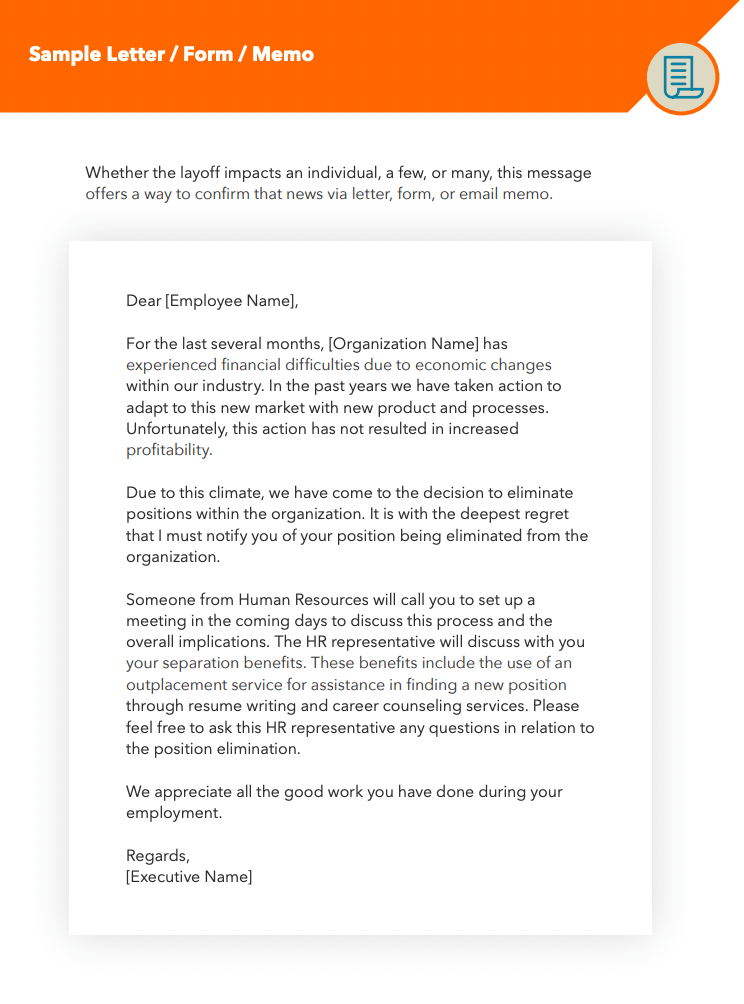
Example letter
Dear [Employee Name],
Following our conversation today, this letter confirms that [Company Name] is undergoing a strategic organizational restructuring. As a result of these structural changes, your position as [Job Title] is being eliminated, and your employment will end on [Final Date].
This decision results from shifting business priorities and in no way reflects your individual performance, dedication, or contributions.
To support your transition, [Company Name] is offering the following, contingent on signing a Separation and Release Agreement:
- Severance pay: [Number] weeks of base pay, totaling [Amount].
- Health benefits: Coverage continues through [Date], after which COBRA applies.
- Accrued time off: Payment for all unused [PTO/vacation] through your final day.
- Outplacement support: Career coaching and resume help through [Provider Name].
Next steps:
- You will receive the Separation Agreement by email today and have [21 or 45] days to review it.
- Please return your laptop and badge to [HR Contact] by [Date].
- HR will meet with you at [Time] to review benefits and answer questions.
We appreciate your work and wish you the best in your next role.
Sincerely,
[Your Name], [Your Title]
Adapt the bracketed fields to your situation, but keep the opening structural reason intact.
A phrase like “strategic organizational restructuring” or “realignment of departmental resources” signals the cut is business-driven and consistent across the organization.
Why the restructuring reason must match everywhere
The reason in a restructuring layoff letter has to match what managers say verbally and what internal memos and company-wide announcements state.
If the letter cites restructuring but the all-hands email blamed a revenue miss, that inconsistency stands out in any legal review.
Restructuring framing protects the organization only when it is true and consistent.
Three checks keep it defensible:
- The narrative aligns. The letter, the verbal script, and the company announcement all give the same structural reason.
- The structure actually changed. There is a real merger, realignment, or layer removal behind the decision, not a relabeled performance issue.
- The selection is documented. Records show why this role, not this person, was chosen for elimination, the same standard a position elimination letter relies on.
A layoff script keeps the verbal notification aligned with the written letter, which is the most common place consistency breaks down.
Legal requirements for a restructuring layoff letter
A restructuring layoff letter must comply with the federal WARN Act, the OWBPA for employees over 40, and state final-pay laws.
These rules govern timing and content, and missing them carries financial penalties.
Three legal points apply to most US restructuring layoffs:
- WARN Act: Employers with 100 or more employees must give 60 days’ advance written notice of a mass layoff or plant closing. Staggered restructuring cuts are tracked over rolling 90-day windows, so smaller reductions can combine to trigger the threshold.
- OWBPA: For employees aged 40 or older, a valid severance waiver requires a 21-day review period for an individual restructuring layoff, or 45 days for a group layoff, plus a 7-day revocation window after signing.
- State final-pay laws: Some states require the final paycheck on the last day of work, others allow the next regular cycle. Check the rule for each employee’s work location.
Always route the final letter through employment counsel before it goes out.
The WARN Act notice rules and severance terms for employees over 40 vary by state, and a letter that is compliant in one state can fall short in another.
For multi-state restructures, a reduction in force plan keeps notice timing and documentation aligned across jurisdictions.
Common restructuring layoff letter mistakes to avoid
The most common restructuring layoff letter mistakes are vague wording, sending the letter before the verbal meeting, inconsistent reasons, and missing legal timing.
Each one increases legal exposure or erodes trust.
Avoid these specific errors:
- Leading with euphemisms: Vague openings leave the employee unsure whether they are losing their job. State the elimination directly.
- Letting the letter break the news: A written notice should always follow a face-to-face or video conversation, never precede it.
- Over-explaining the restructuring: Long passages about company financials or strategy add legal risk and dilute the message. Keep it to logistics and next steps.
- Inconsistent reasoning: If the letter, the manager, and the company announcement give different reasons, the restructuring looks like a cover for something else.
- Ignoring the 40-plus rules: Skipping the OWBPA review window can void a severance waiver entirely.
Each mistake is avoidable with a single review pass before the letter goes out.
Read it as the employee will: under stress, looking for the date, the money, and what to do next.
If those three answers are not immediate and unambiguous, rewrite it.
Key takeaways
- A layoff letter due to restructuring confirms in writing that a role is eliminated because of a structural business change, and follows a verbal meeting rather than replacing it.
- Every restructuring letter needs seven elements: separation statement, restructuring reason, effective date, compensation, benefits, transition support, and a contact.
- Lead with the decision in the first sentence and tie it clearly to the structural change, not performance.
- Comply with the WARN Act, OWBPA review windows for employees over 40, and state final-pay laws, then have counsel review the final draft.
- Match the restructuring reason across the letter, verbal notifications, and company announcements, because inconsistencies create legal risk.
FAQs
Common questions HR teams ask when writing a layoff letter due to restructuring.
Is a layoff letter due to restructuring legally required?
A standalone letter is not always required, but written notice is mandatory under the WARN Act for mass layoffs at larger employers, and a written severance agreement is required to obtain a valid release from employees over 40.
Most organizations issue a restructuring letter regardless, because it documents the structural reason and reduces dispute risk.
How do you explain restructuring in a layoff letter?
State that the role is eliminated because of a structural change, such as a department merger or realignment, and confirm it is not related to performance.
Use the same wording leadership used in company-wide announcements so the reason stays consistent.
Should a restructuring layoff letter be emailed or delivered in person?
The layoff should be communicated in a live meeting first, in person or by video, with the letter following immediately as written confirmation.
The letter should never be the first way an employee learns their role is eliminated.
A restructuring is hard on everyone, and the layoff letter is where that difficulty becomes visible to the people affected.
Get the structural reason, timing, and support right, and you protect both the departing employee and the trust of everyone who stays.
If you are planning a restructuring and want to give impacted employees real support to land their next role, speak with a Careerminds expert.



bring the CHALLENGE.
wE have the SOLUTION.
Protect your brand and support your people through change. From career transition to leadership development, we bring clarity and care to the moments that matter most.