

AI-led layoffs: What HR leaders wish they knew before making job cuts
February 19, 2026 Written by Careerminds

Compare providers
Download our outplacement comparison sheet

Request pricing
Compare our rates to other providers
In the last year, over 100,000 workers found themselves out of work as companies rushed to replace human roles with intelligence that promised to work faster, cheaper, and without lunch breaks.
Klarna became the poster child of this movement. The Swedish fintech’s headcount dropped from 5,500 to just 3,400, with the company publicly declaring that AI could do all of the jobs humans do. They celebrated $10 million in savings — until customer satisfaction fell sharply, complaints mounted, and cracks started to show. By mid-2025, Klarna’s CEO started rehiring those roles.
Klarna isn’t alone, either, as new research has found that businesses are already quietly reversing course, leaving HR leaders caught in the middle, tasked with rebuilding workforces that their organizations were quick to dismantle.
What we did:
In February 2026, Careerminds surveyed 600 HR professionals who made layoffs in the last 12 months to understand the real impact of AI-driven workforce restructures and whether organizations would approach those decisions differently today.
The scale of AI-driven layoffs
Over three in four HR professionals confirmed that in the last twelve months, their organization has laid off employees due to technological advancements like AI replacing roles and responsibilities. It was found that entry-level roles bore the brunt of the workforce reduction, with almost one in three (31.5%) HR leaders stating they were the most affected by AI layoffs in their company. Mid-level contributors followed at 15.6%.
9 in 10 companies would rethink AI layoffs if they were given the chance
For all the confidence with which these decisions were made, the regret is hard to ignore. Only 8.4% of HR leaders stated their AI-driven restructure delivered what was promised and would repeat the process unchanged – meaning an overwhelming nine in ten would approach things differently if given the chance.
Over four in ten (41.2%) of HR leaders say they would definitely approach AI-driven redundancies differently if given the chance. A further 50.3% would make selective changes, such as rethinking which specific roles were cut rather than overhauling the entire approach. Just over 8% of respondents stated they would stick to the same approach.
The reality check: When AI didn’t deliver
Many leaders, upon retiring roles for automation, have hopes of a shortcut through the messy business of managing real people. However, the reality behind the numbers isn’t as bright as the expectation. When asked whether the replacement of roles with automation reached expectations, one in eight (12.3%) of companies stated that the problems caused by the layoffs outweighed the ones they solved.
66.1% of HR teams stated that some roles were replaced successfully with automation – but not all. Just 21.4% of respondents stated AI fully replaced those roles with no operational issues.
32% of organizations lost critical skills with AI layoffs
What companies discovered after the dust settled was that many of the roles that were written off as replaceable turned out to be anything but. One in three (32.9%) HR workers stated they lost critical skills and expertise with laid-off employees, and more tellingly, 28.1% stated that the remaining workforce didn’t have the skills to fill the knowledge gap left by the layoffs.
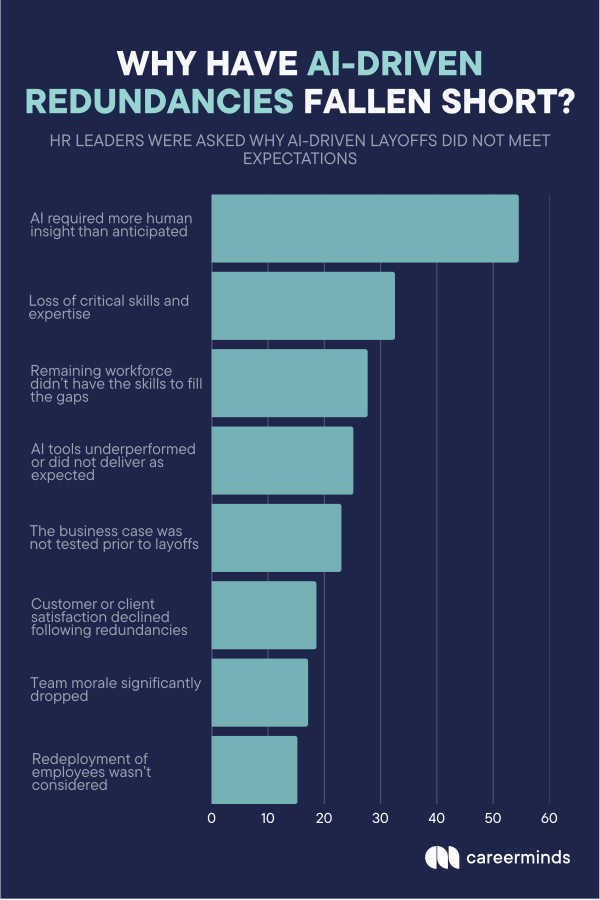
Most prominently, a staggering 54.6% companies felt that the layoffs weren’t worth it as they found themselves babysitting the technology, given that it required more human oversight than originally anticipated.
Companies getting AI right aren’t using it to replace people, but removing frictions in their workload. Tripadvisor is a strong example, deploying AI to handle routine tasks so customer support teams could focus on complex cases that genuinely require human judgment. The goal was a more capable workforce, not a smaller one.
Most organizations rehire laid-off employees within 6 months
Forrester’s 2026 Future of Work outlook, released late 2025, predicts that half of AI-attributed layoffs would be quietly reversed by 2027. However, the Careerminds research finds that 32.7% of companies that have conducted AI-led layoffs have already rehired between 25-50% of the roles they initially let go. 35.6% of companies surveyed stated they rehired for more than half of the roles they laid off.
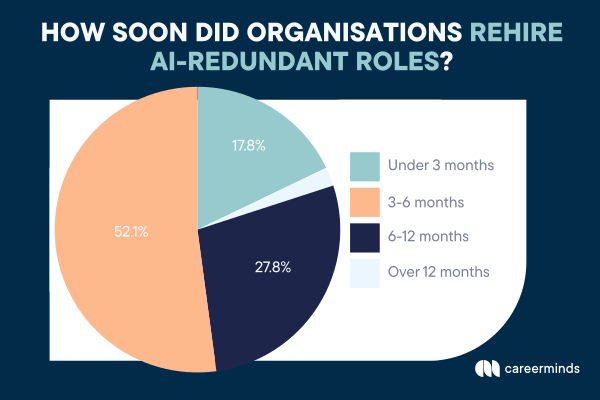
When organizations did rehire, they did so quickly. Half of HR leaders (52.1%) said their organization rehired for previously eliminated roles within just six months, while a further 17.8% had already begun rebuilding their workforce within three months. Only 2.1% of companies waited over a year.
The speed of the reversal speaks for itself. The value of those roles became clear in their absence, and unfortunately, workforce decisions made at speed can take longer to recover from.
75% of organizations found AI redundancies cost more than they saved
Replacing human roles with AI is widely known as a key way to reduce operational costs. But for a significant number of organizations, that calculation didn’t hold up.
Nearly one third (30.9%) of organizations found that bringing those roles back cost them more than they ever saved by cutting them in the first place — meaning they’re financially worse off than if they’d never made the redundancies at all. A further 42.37% broke even, with rehiring costs cancelling out any initial savings. Only 26.69% came out ahead.
What’s more, is that figure doesn’t account for hidden costs that don’t make it into a spreadsheet: lost productivity, declining team moral and loss of institutional knowledge.
Up to a quarter of laid-off roles could have been saved
Over half (51.3%) of companies believe that up to a quarter of the roles their organization made redundant could have been transitioned into a different role, with the right redeployment support in place. A further 28.3% of HR teams estimate that between 26-50% of roles had redeployment potential.
However, for over 1 in 2 (55.1%) of companies, reskilling and redeployment weren’t formally discussed or considered. Redeployment isn’t just a more human approach to workforce transition; redistributing your workforce into other roles preserves institutional knowledge, reduces re-recruitment costs, and offsets the damage to morale that comes with reducing your workforce.
Better workforce planning equals better outcomes
When asked how companies would improve their organization’s approach to restructures, over half of HR leaders (53.8%) stated they would have been able to make more informed decisions in AI redundancies, had their company had a clearer understanding of AI’s capabilities.
40.6% of companies highlight they would benefit from more data on employee capabilities and skills, whereas 1 in 3 (33%) say that the ability to hypothetically test workforce change scenarios before committing to them would have made a significant difference to their approach.
What ties all these findings together is that the organizations that struggled the most were making significant, irreversible decisions without the full picture of AI capabilities and what a reduction would do to their workforce. Understanding which roles are genuinely at risk of automation, mapping skills already present in your workforce, and being able to model restructuring scenarios before committing to them – that’s where Careerminds’ Workforce Intelligence comes in. It’s the difference between making workforce decisions in the dark and making them with clarity.




bring the CHALLENGE.
wE have the SOLUTION.
Protect your brand and support your people through change. From career transition to leadership development, we bring clarity and care to the moments that matter most.