


Compare providers
Download our outplacement comparison sheet

Request pricing
Compare our rates to other providers
AI has crept into working life in that quiet, slightly unsettling way new technology always does — one minute it’s a handy tool, the next it’s the thing everyone’s whispering about over coffee.
Some workers are excited, others are wary, and most are simply trying to figure out what all of this means for their future. One thing, however, is becoming clear: many Americans believe the rapid arrival of workplace AI now needs guardrails.
Our survey found strong support for a federal “AI Worker Bill of Rights” — a national framework that could set rules around transparency, human oversight, and worker protections as companies adopt AI tools.
Right now, however, protections remain a patchwork. A few states have begun introducing legislation, including Illinois’ HB 3773, which takes effect on January 1, 2026, and requires employers to disclose when AI is used in hiring or employment decisions.
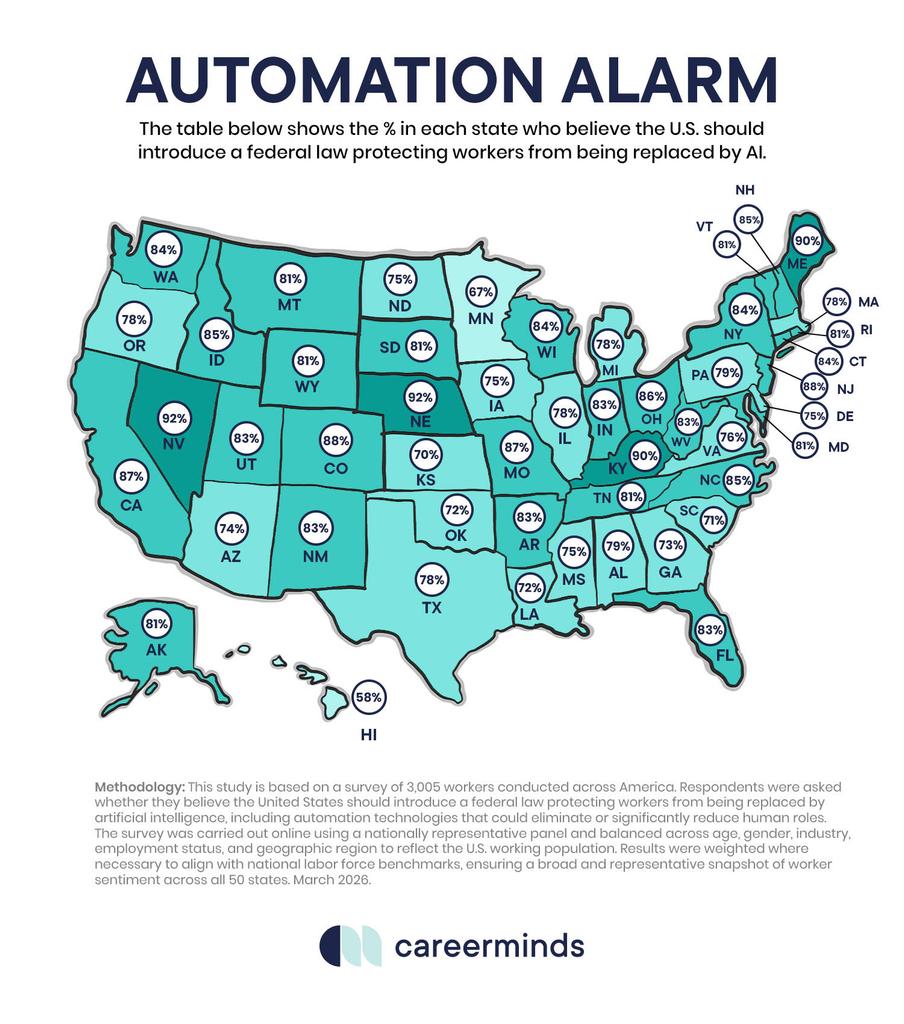
While helpful, measures like this stop short of offering a nationwide safety net, which helps explain why 81% of workers in our survey say the federal government should introduce a law protecting employees from being replaced by AI.
Key Findings
Workers are far more worried about process than replacement.
The standout anxiety isn’t necessarily losing a job — it’s losing it without warning. The fear of being quietly swapped by an algorithm (32%) outranks concern about unfair application screening or AI-generated performance reviews. It’s less Terminator, more HR ghosting.
High suspicion that AI is already influencing jobs.
A striking 64% of workers suspect that AI has already influenced a decision made by their employer about their job, such as promotions, scheduling, or performance evaluations. This suggests many employees believe the AI transition isn’t coming; it’s already happening behind the curtain, and they are simply not being told.
Support for retraining is almost universal.
With 82% backing mandatory retraining if companies adopt AI that cuts jobs, the data hints at something deeper: workers aren’t resisting automation itself. They are resisting being left behind by it.
People want humans involved, even if AI gets the final say.
Human review of major decisions (40%) ranks as the top desired protection — far higher than compensation, retraining, or limits on surveillance. The takeaway: workers don’t necessarily want to ban AI; they want a human in the room making the final workforce and career decisions.
Job insecurity doesn’t skew entirely toward vulnerable industries.
The 28% who think AI will “very likely” replace their job in the next five years aren’t just in tech or admin roles. Many are in service professions, suggesting the fear isn’t tied to actual exposure — it’s tied to the narrative around AI as a whole.
Transparency is becoming a cultural expectation, not a perk.
With 84% wanting companies to disclose any AI use in hiring or evaluation, trust appears to be the currency employers are running dangerously low on. Workers don’t necessarily expect companies to stop using AI — they just expect them to stop hiding it.
Final thoughts
What these numbers really show is that workers aren’t afraid of AI itself — they are afraid of the opacity around it. People can handle new tools, shifting workflows, and even the possibility of job transformation.
What they are struggling with is a system where decisions that shape their livelihoods can be made by software they never see and policies they never approved.
And until companies — or the federal government — offer clearer rules, transparency, structured support for career mobility, and a sense of shared control, AI will feel less like a tool and more like a threat.




bring the CHALLENGE.
wE have the SOLUTION.
Protect your brand and support your people through change. From career transition to leadership development, we bring clarity and care to the moments that matter most.