


Compare providers
Download our outplacement comparison sheet

Request pricing
Compare our rates to other providers
When a company reduces its workforce, departing participants need more than a severance check.
Outplacement gives them the structured, professional support to land their next role, while protecting the organization’s reputation in the process.
What is outplacement?
Outplacement is an employer-sponsored service that provides professional career support to employees who have been laid off or separated from their organization, helping them find new roles faster and with more confidence.
Companies typically offer it as part of a severance package during layoffs, reductions in force, or restructuring events.
The terms outplacement, career transition services, and outplacement assistance are used interchangeably across the industry and refer to the same core offering: structured support that covers every stage of the job search, from personal branding through to offer negotiation.
How outplacement differs from severance
Severance replaces income for a defined period.
Outplacement replaces the infrastructure of a job search: the expert coaching, the platform access, and the accountability of a dedicated professional working alongside each participant toward a concrete outcome.
They serve different purposes and work best when offered together as part of a complete separation package.
What are outplacement services?
Outplacement services are the specific components a program delivers to participants during a career transition.
Most programs combine human coaching with digital tools to cover every stage of the job search.
Core services typically include:
- Career coaching: Dedicated one-on-one sessions with an experienced coach. Coaches help participants clarify goals, identify transferable skills, and build a focused search strategy tailored to their background and target market.
- Resume and LinkedIn development: Professional review and rewriting of resumes, cover letters, and LinkedIn profiles to pass applicant tracking systems and attract recruiter attention in a competitive market.
- Interview preparation: Structured mock interviews and feedback sessions, including video interview practice, to build confidence and sharpen responses before live conversations begin.
- Job search tools and technology: Access to job boards, AI-assisted job-matching platforms, automated alerts, and curated role recommendations matched to each participant’s profile.
- Networking support: Guidance on working with recruiters, reaching professional contacts, and accessing the hidden job market, which fills the majority of roles across most industries.
- Upskilling and learning resources: eLearning libraries, workshops, and skills assessments that help participants close gaps and stay competitive as they move into their next role.
The depth and quality of these services varies significantly between providers.
Legacy outplacement firms often deliver group workshops and time-limited packages with high coach-to-participant ratios.
Modern providers offer dedicated one-on-one coaching, unlimited program access, and global delivery.
What is the most common outplacement process?
The outplacement process typically follows six structured phases, from the moment a participant is notified through to placement in a new role.
1. Onboarding and initial assessment
The provider contacts the participant shortly after the separation.
A dedicated coach conducts an intake conversation covering career history, immediate priorities, and goals.
The output is a personalized transition plan that sets the direction for the entire program.
2. Personal branding and materials
The coach and participant work through resume development, LinkedIn optimization, and cover letter templates.
In today’s market, materials need to clear applicant tracking systems and generate recruiter interest quickly.
This phase ensures participants enter the market with the strongest possible first impression.
3. Career coaching and strategy
Regular one-on-one coaching sessions address job market positioning, target role identification, and search strategy.
Coaches help participants navigate uncertainty, stay focused, and adapt their approach based on real-time feedback.
This is where the coaching ratio matters most.
At Careerminds, a 30:1 coaching ratio means each coach carries far fewer participants than legacy outplacement models, which translates to more time, more attention, and more tailored guidance per person.
4. Job search and networking
With materials ready and a strategy confirmed, participants activate their job search.
Coaches guide outreach to recruiters and professional contacts, introduce job-matching technology, and help participants work both visible job postings and the hidden market.
5. Interview preparation
Mock sessions, targeted feedback, and salary research prepare participants to convert conversations into offers more consistently.
When applications generate interest, the focus shifts to interview performance.
6. Offer, negotiation, and placement
The process concludes when a participant accepts a role.
Some programs include first 90-days coaching to help them succeed in their new environment.
What are the benefits of outplacement?
Outplacement benefits both participants going through a transition and the organizations that provide it.
According to Careerminds research, 90% of HR leaders say career transition services are essential and a business imperative, not a discretionary spend.
For participants, the core benefit is speed.
Professional coaching, optimized materials, and a structured search strategy reduce the time between roles.
Participants also report stronger confidence and better role fit when they work with a dedicated coach rather than navigating the search independently.
For employers, the benefits are strategic:
- Employer brand protection: How an organization treats departing employees shapes how the market perceives it. Careerminds research shows that over 50% of HR leaders faced morale loss, brand damage, and declining trust following poorly handled layoffs.
- Survivor morale: Remaining employees watch how departing colleagues are treated. Outplacement signals that the organization values its people, which supports engagement and retention in the period following a reduction.
- Reduced legal exposure: Participants who receive structured support are less likely to pursue claims against their former employer.
- Lower unemployment costs: Faster re-employment reduces the duration and volume of unemployment insurance claims in jurisdictions where employer rates are tied to claim history.
How can outplacement help employees during a layoff?
Outplacement helps participants in three distinct ways during a layoff: it reduces the time they spend unemployed, it provides structure during a disorienting period, and it gives them a professional edge they wouldn’t have alone.
Practical job search support
Participants who enter a job search without structured guidance often spend weeks on ineffective approaches: applying to roles that don’t fit their profile, sending generic resumes, and avoiding the networking conversations that actually generate opportunities.
A dedicated coach corrects those habits from the first session, building a focused strategy instead of letting participants default to the path of least resistance.
Emotional support and confidence
Losing a job ranks among the most disruptive experiences a person can face.
A dedicated coach provides accountability and perspective at exactly the point when both are hardest to maintain independently.
Participants with consistent coaching report higher confidence and greater clarity about what they want from their next role, not just the first available option.
Long-term career clarity
Outplacement done well prompts participants to interrogate what they actually want: the right function, the right culture, and the right level of seniority.
HR leaders sometimes underestimate this benefit.
That clarity produces better outcomes for the participant and reflects well on the organization that invested in getting them there.
Speed to re-employment
The speed benefit is measurable.
Our participants reach placement in an average of 11.5 weeks.
That’s faster than most participants would achieve without support, and it means less time drawing on severance, lower financial stress, and a faster return to full productivity in a new role.
How does outplacement work for employers?
From the employer’s perspective, outplacement works in four stages: selection, activation, delivery, and measurement.
- Selection happens before the reduction event, ideally with enough lead time to configure the program for the participant group. The employer and provider agree on the delivery model, coaching structure, and reporting format. The more complex the workforce event, the more value there is in working through these details in advance.
- Activation happens on the day participants are notified. Good providers ensure participants receive a first contact within 24 to 48 hours of notification. Slow activation is one of the most common failure points in outplacement delivery. Participants who don’t hear quickly disengage, and disengaged participants take longer to place.
- Delivery is the coaching, tools, and resources that flow directly to participants. The employer monitors progress through regular reporting.
- Measurement closes the loop. When programs conclude, the employer reviews placement rates, average time to land, and participant satisfaction data. These metrics form the basis of the renewal decision and inform how the organization approaches future workforce events.
What is an example of outplacement?
Here is a concrete example of how outplacement works in practice.
The situation: A mid-sized financial services company announces a restructuring that eliminates 80 roles across its operations and finance teams. The CHRO engages an outplacement provider before notifications go out.
What happens for participants:
- On notification day, each participant receives a welcome message from the outplacement provider alongside their separation paperwork.
- Within 48 hours, each participant connects with a dedicated coach for an intake call and a personalized transition plan.
- Over the following weeks, coaches work with participants on resume development, LinkedIn profiles, job search strategy, interview preparation, and offer negotiation.
- Participants access a digital platform with job-matching tools, eLearning content, and networking resources throughout the program.
The outcome: Ten weeks later, the majority of participants have accepted new roles. The CHRO reports placement rates and average time to land to the executive team. The company’s employer review profile reflects the care taken with departing participants, and the remaining workforce holds steady because they watched their colleagues leave with real support behind them.
This structure plays out across every sector and every scale of workforce event.
The specifics vary but the principle holds: participants who receive structured, dedicated support land faster and leave with a better impression of their former employer.
What are the types of outplacement services?
Outplacement programs come in four main types.
The right model depends on the seniority of the participants, the scale of the workforce event, and the organization’s goals.
| Type | Who it’s for | What it includes |
|---|---|---|
| Individual outplacement | All levels, delivered per person | Dedicated coach, resume development, job search tools, interview prep |
| Group outplacement | Large-scale reductions | Workshop-based delivery, shared sessions, group resources |
| Virtual outplacement | Remote or distributed workforces | Digital platform, video coaching, global access across time zones |
| Executive outplacement | Senior leaders and C-suite | High-touch coaching, executive positioning, board-level search strategy |
Most modern providers deliver a blend of individual coaching and virtual outplacement delivery, which gives participants flexibility without sacrificing the one-on-one relationship that drives results.
Legacy outplacement models built around group workshops tend to produce weaker individual outcomes because participants receive less dedicated coaching time and less tailored support per person.
The failure mode here is choosing on price alone.
A cheaper group program may cost less per head, but if participants take longer to land or disengage entirely, the employer ends up spending more on extended severance and carrying greater reputational risk.
For senior leaders, executive outplacement involves a higher level of career positioning support, including board profile development and access to executive search networks.
How do you choose an outplacement firm?
The right provider makes a measurable difference to placement speed, participant satisfaction, and employer brand outcomes.
Here are four steps to evaluate your options.
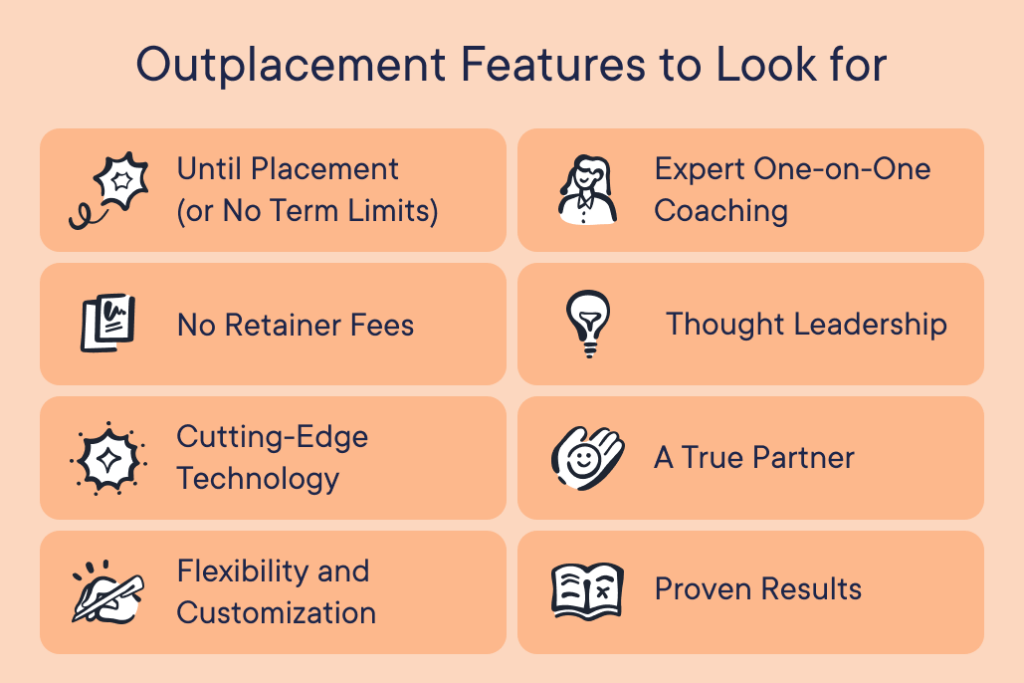
1. Check the program model: Ask whether the provider supports participants until they land or cuts off access after a fixed number of weeks. Time-limited programs leave participants exposed if the search takes longer than expected. A provider confident in its results offers support until placement.
2. Assess the coaching ratio: Find out how many participants each coach carries. High ratios mean less individual attention and slower placement.
3. Evaluate the technology: The platform should give participants on-demand access to job-matching tools, eLearning content, and coaching resources. It should also give you, the employer, real-time visibility into engagement and placement progress, not a summary report at the end.
4. Ask for outcome data: Any provider worth considering should share placement rates, average time to land, and participant satisfaction scores from real programs. If they can’t, that’s a signal.
How will outplacement develop in the next 5 years?
Outplacement is changing faster than at any point in its history, driven by AI, shifting workforce demographics, and the growing expectation that career support should be continuous rather than triggered only by a layoff.
Three developments will shape the next five years:
- AI-assisted job matching: Smarter platforms will match participants to roles faster and with greater precision, reducing the time spent on unfocused applications.
- Always-on career support: The line between outplacement and ongoing career development will blur. Organizations will increasingly offer transition support as a standing benefit rather than a reactive one.
- Greater emphasis on skills over titles: Coaches will focus more on transferable skills and emerging role categories, helping participants move into new functions rather than simply replacing their last job.
Frequently asked questions
Here are the questions HR leaders and participants ask most often about outplacement services.
What is the difference between outplacement and severance?
Severance is a financial payment made to a departing employee for a defined period after separation.
Outplacement is a structured career support service that provides coaching, tools, and resources to help the participant find a new role.
They serve different purposes and work best when offered together as part of a complete separation package.
How long does outplacement last?
Program length varies by provider.
Time-limited programs typically run between 4 and 12 weeks.
Who pays for outplacement services?
The employer pays for outplacement services.
Participants receive the program as an employer-sponsored benefit at no cost to themselves, typically as part of their severance package.
What is outplacement assistance?
Outplacement assistance is another term for outplacement services.
It refers to the professional career support an employer provides to help departing employees transition into new roles, including coaching, resume development, interview preparation, and job search tools.
What is the difference between outplacement and redeployment?
Outplacement supports employees who are leaving the organization, helping them find new roles externally.
Redeployment supports employees who remain, moving them into different roles within the same organization to fill gaps and retain talent.
Both are tools for managing workforce change, and many organizations use them alongside each other during a restructuring event.

Insights and research



bring the CHALLENGE.
wE have the SOLUTION.
Protect your brand and support your people through change. From career transition to leadership development, we bring clarity and care to the moments that matter most.